• ChatGPT and a Search Console: What Marketers Can Actually Measure

    ChatGPT now has something close to a Search Console, but it is a small, early one. “ChatGPT Search Console” is an industry nickname; OpenAI calls the tool Business Hub, part of a beta called Businesses in ChatGPT that Relevant Audience and HelloGrowth report OpenAI launched on 10 November 2026.

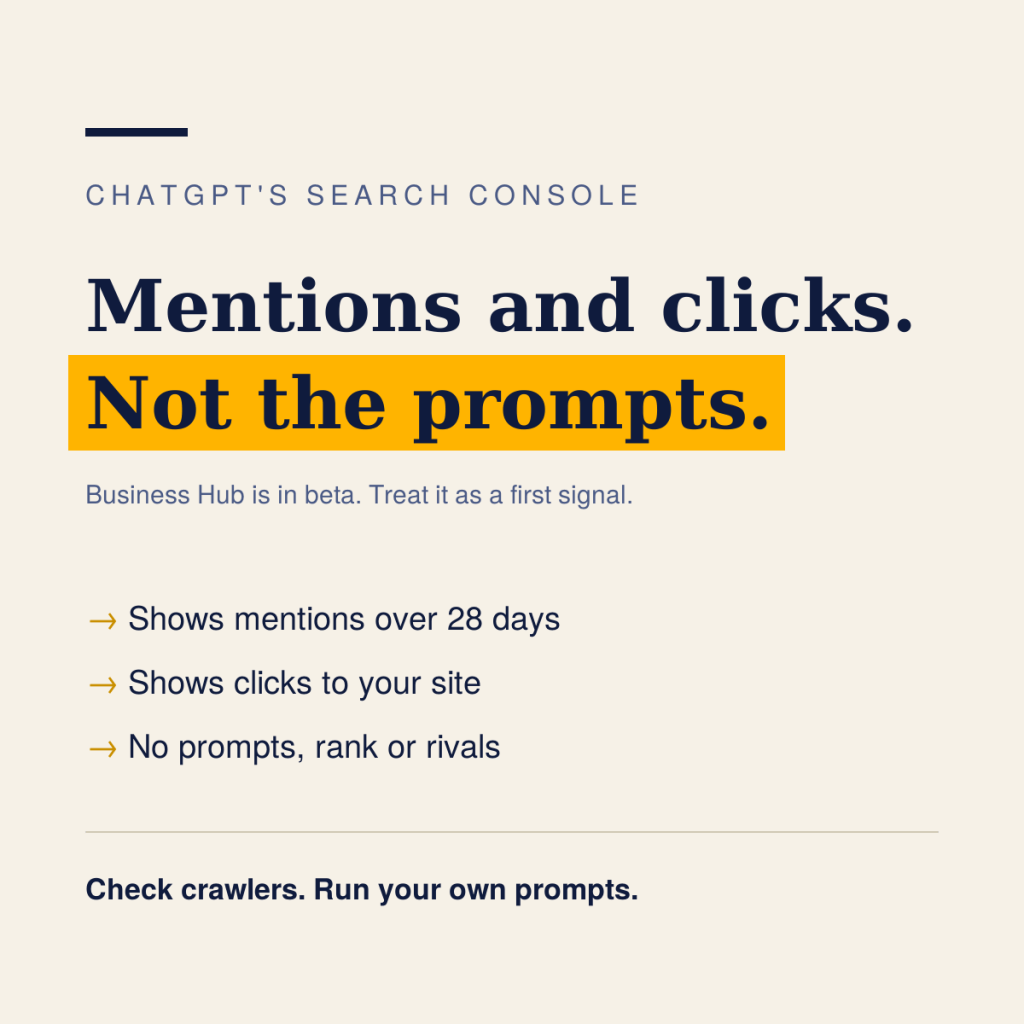
    It tells you how often ChatGPT mentions your business and how often people click through to your site. It does not show you the prompts, your ranking or your competitors. Marketers should treat it as a first signal, not a full measurement system.

    What OpenAI has launched

    Business Hub lets an eligible business claim its listing in ChatGPT, update key details and add product feeds with pricing and availability. A separate Insights view reports how ChatGPT is surfacing you. Per Relevant Audience, Business Agents, a branded assistant that answers questions inside ChatGPT, sit alongside it.

    According to HelloGrowth, citing OpenAI’s help article, Insights cover the past 28 days and show three things:

    MetricWhat it countsCaveat
    MentionsFor an online business, times ChatGPT referenced your websiteA brand name alone is not a mention
    Website clicksRecorded clicks on links to your sitePer OpenAI’s help text, they “don’t confirm website visits or conversions”
    Discovery topicsRecurring themes in answers that cited youThemes only, not individual user questions

    A few conditions shape how useful this is today:

    • Privacy thresholds. Insights appear only once there are enough conversations, so smaller brands may see nothing yet.
    • Verification. HelloGrowth lists a code to a business phone or email, a DNS TXT record, or a Shopify connection, followed by an identity check through a third party, Persona.
    • Geography. Claiming is open wherever ChatGPT is available, but Business Agents are limited at launch to online shops and online services in the United States. Relevant Audience notes that no country list was published.
    • Cost. Free for now, per Digiday as relayed by Relevant Audience; a paid model was not ruled out.
    • No promise of lift. Relevant Audience reports OpenAI saying claiming should not change how often a business appears; HelloGrowth says it does not guarantee more recommendations or sales.

    How it compares with Google Search Console

    Google Search Console tells you which queries brought people to which pages, and where you ranked. Business Hub, as reported so far, tells you only how often and how much. That is a real gap for anyone trying to improve rather than just observe.

    Question a marketer asksGoogle Search ConsoleChatGPT Business Hub (beta)
    How often did we show up?Impressions per query and pageMentions, past 28 days
    Did people click?Clicks per query and pageWebsite clicks, not confirmed visits
    What were people asking?Query dataDiscovery topics only; no prompts
    Where did we rank?Average positionNot shown
    How do we compare with rivals?Not shownNot shown; share of voice is not in the beta
    Can we pull the data out?Export and APINone described, per Relevant Audience

    How to measure ChatGPT visibility today

    Business Hub covers one slice. A workable measurement routine combines it with three things you control.

    1. Check crawler access first. OpenAI’s crawler documentation lists OAI-SearchBot as the bot that surfaces sites in ChatGPT’s search features, controlled by robots.txt, with changes taking about 24 hours to apply. GPTBot relates to model training. ChatGPT-User fetches pages when a person asks, and robots.txt rules may not apply to it. Blocking the wrong one is the cheapest way to disappear.
    2. Look in your own analytics and server logs. Check referral traffic from chatgpt.com and requests from OAI-SearchBot. This is my suggested routine, not an OpenAI-documented report, and it shows visits that Business Hub’s click count does not confirm.
    3. Run a fixed set of prompts on a schedule. Pick ten to fifteen questions a customer would ask, run them weekly, and log whether your brand appears, what ChatGPT says about it, and which sources it cites. This is the manual version of the share-of-answer idea from my earlier post, and it is the only way to see competitors.
    4. Claim your business and read Insights. If you are eligible, treat mentions and clicks as a trend line, not a target. Remember the privacy thresholds and the lack of export.

    Together these answer four different questions: can ChatGPT reach us, did anyone arrive, what does it say, and how often does it mention us.

    A checklist for this week

    • Confirm robots.txt allows OAI-SearchBot, and decide separately on GPTBot
    • Look for OAI-SearchBot in server logs and chatgpt.com in referral reports
    • Write ten to fifteen customer questions and run them in ChatGPT; log the answers and cited sources
    • Ask IT and compliance who would own a Business Hub claim, then try it
    • Fix any wrong or outdated offer you find on pages you control
    • Re-run the prompts weekly and note changes

    Business Hub is a start, and the tool will likely change quickly while it is in beta. The habit of measuring, checking and correcting is worth building now, whatever OpenAI adds next.

    Sources

  • Festive-Season Marketing When Shoppers Ask AI First

    The festive buying window is already open, and a growing share of shoppers may be asking an AI to help them decide before they ever see your ad or visit your store. That changes what your offer needs to be: not just attractive, but easy for a machine to read, compare and describe correctly.

    This post covers what research from Google and others says about AI-assisted festive shopping in India, how an AI answer is likely to treat your offer, what it means for financial services brands, and a short plan for this week, festive week and after. What the research says about AI-assisted festive shopping in India

    The best-documented source is Google’s own, so read it as Google’s view. In an 8 October 2026 blog post, Google India drew on an Ipsos survey it commissioned. The survey covered 2,450 Indian shoppers aged 18 and over who had shopped for Navratri or Diwali in the previous two days, across seven categories including jewellery, apparel, mobile devices and appliances. It was fielded from September to November 2025, so it describes last year’s festive season, not this one (Google India). Its main findings:

    • 51% of festive shoppers who used AI said it helped them make better decisions, and they consulted chatbots about 7.5 times on average.
    • Among people who used AI chatbots, 94% also used Google Search and 87% also used YouTube. AI adds a step to the journey. It does not replace the others.
    • 73% looked to online creators for inspiration, and 7 in 10 shoppers who spotted a product on a social feed turned to Google Search to check it.
    • 90% saw delivery within two days as essential, and 81% chose a retailer on delivery speed.

    A second source, InMobi, an ad-tech vendor, reports that about 4 in 5 festive shoppers want AI shopping assistants, and that 27% rank brand trust as their top purchase factor against 22% for discounts. Its press release gives no sample size or method, so I would treat those figures as directional only (InMobi, 24 September 2026). It also reports that 29% of shoppers buy a week or less before the festivals begin, which is the window we are in.

    The pattern across both is consistent, even if the numbers need care: people research deliberately, use several channels including AI, and then buy quickly when something is easy to trust and easy to get. Neither source covers financial products specifically.

    How an AI answer is likely to treat your offer

    This section is my analysis, built on what is publicly known about how these tools behave. Nobody outside the platforms knows exactly how they pick and summarise offers.

    A festive offer is a short-lived, detailed claim: a rate, a cashback, a date range, conditions. That is exactly the kind of thing an AI answer can get wrong in three ways:

    • It can quote an old version. If last year’s offer, or an expired one, is still on a page, a partner site or a PDF, an answer may repeat it. Google’s guidance for its AI features asks site owners to keep business and product data current in Merchant Center and Google Business Profile (Google Search Central).
    • It can drop the conditions. A summary tends to keep the headline and lose the fine print. “Up to 10% cashback” can become “10% cashback”.
    • It can misattribute. A BBC-led study with the European Broadcasting Union found 45% of AI assistant answers to news questions had at least one significant issue, and 31% had sourcing problems (Al Jazeera). That study covered news in 2025, not offers, but the failure mode of a confident answer that does not match its source is the same one.

    What helps is the same thing that helps in any AI answer: one clear, dated, factual page per offer, with the conditions in plain words next to the headline, and the same terms everywhere the offer appears.

    What it means for BFSI and fintech brands

    The festive calendar this year is tight. One calendar source gives Dhanteras on Friday 6 November and Diwali on Sunday 8 November 2026, though it notes religious dates can shift by a day or two depending on the calendar followed (India Marketing). That leaves days, not weeks, for anything not already live.

    For financial services, four things stand out:

    1. A festive offer is a regulated claim, and an AI will repeat it. Card cashback, a processing-fee waiver or a festive rate has conditions, a validity period and, often, required disclosures. Put them in the same place as the headline, in plain language, so a summary is less likely to separate them.
    2. Big-ticket purchase moments create finance questions. Shoppers comparing a phone, jewellery or appliances ask about EMI, no-cost EMI, card offers and loan terms. Those are questions an assistant may answer using whatever it finds. Make sure the correct terms for your products are easy to find and consistent.
    3. Trust is the tiebreaker. If, as one vendor survey suggests, shoppers weigh brand trust nearly as much as discounts, a financial brand should lead with clarity and credibility, not only the offer. Treat that survey as directional, since it discloses no method.
    4. Speed matters, but not at the cost of accuracy. The research shows people buy fast. A wrong figure in a fast-moving answer creates a complaint you will have to handle in the busiest week of the year.

    Be careful about promising returns or outcomes in festive creative, and check each offer against your compliance team’s rules and each platform’s policies before it goes live.

    What to do now

    Before Diwali (the next few days)

    • Ask five of the questions a shopper would ask about your festive offer in the AI tools your customers use. Note what each says about your offer and whether it is right.
    • Make one dated, plain-language page per live offer: the headline, the conditions, the end date and who it is for.
    • Take down or clearly mark expired offers, including old PDFs, partner pages and app store text.
    • Check the offer terms match on every channel: site, app, social, partner pages and sales scripts.
    • Brief service and sales teams on the exact wording, since customers will arrive quoting what an AI told them.
    • Update Google Business Profile and any product feeds with festive hours and offers.

    Festive week

    • Re-run your five questions daily and log any wrong answer with a screenshot.
    • Fix the source of any error you can control. Report the rest through the platform’s feedback route where one exists.
    • Keep a named person on call for corrections, with compliance sign-off ready.

    After the festival

    • Compare what AI said about your offer with what you intended, and note the gaps.
    • Retire every festive page with a clear end message, not a silent deletion.
    • Write the lessons into next quarter’s offer checklist.

    What not to do

    • Do not rely on the offer headline alone. If the conditions are not near it, they may not survive a summary.
    • Do not publish dozens of near-identical festive pages. Google calls mass-producing pages to manipulate rankings or AI responses scaled content abuse (Google Search Central).
    • Do not chase AI visibility tools mid-campaign. Google says no third-party tool has access to its internal ranking or AI systems, so a score is a sample, not a measurement.
    • Do not let generated festive creative skip review. A fast tool and a short deadline are when wrong claims get through.
    • Do not treat AI as the only channel. In Google’s survey, nearly all chatbot users also used Search and most also used YouTube.

    How to measure what worked

    Keep it small enough to do in a busy week.

    • Answer accuracy. Of the answers you checked about your offer, how many were right on the headline and the conditions? Log each error and its source.
    • Offer-page performance. Visits, applications and completions on the dated offer pages, compared with the same pages before the festive push.
    • Customer questions. The number of service queries that quote an offer wrongly. This is the cost of an error showing up in your own data.
    • Brand search. Branded search volume in Search Console before, during and after, as a sign that your name is being looked for.

    With a few days of data and a small question set, you are looking for direction and for errors to fix, not proof that AI drove sales. Write down your five questions now so next year’s comparison is fair.

    The takeaway

    Shoppers are using AI as one more step in a journey that still runs through search, video and creators. For a festive offer, the practical risk is not that AI ignores you. It is that it describes your offer wrongly, in the week you can least afford it. Make each offer easy to read, dated and consistent, check what the answers say, and fix what you can. In financial services, a clear and correct offer is the more trusted one.

    Sources

  • Share of Answer: A New Brand Metric

    Marketers have spent years measuring how visible a brand is with share of voice, rankings and clicks. When an AI answers the customer’s question directly, those numbers miss the moment that matters: whether your brand is in the answer, and what the answer says about it.

    I am calling the missing measure share of answer. It is my working label, not an industry standard, and no one has published a single agreed definition. This post sets out a way to define it, how much to trust any single reading, a scorecard you can start with, and where the metric breaks. The evidence is early, so I flag what is research, what is vendor opinion and what is my own proposal.

    What share of answer is, and what it is not

    This section is my proposal, not an established definition.

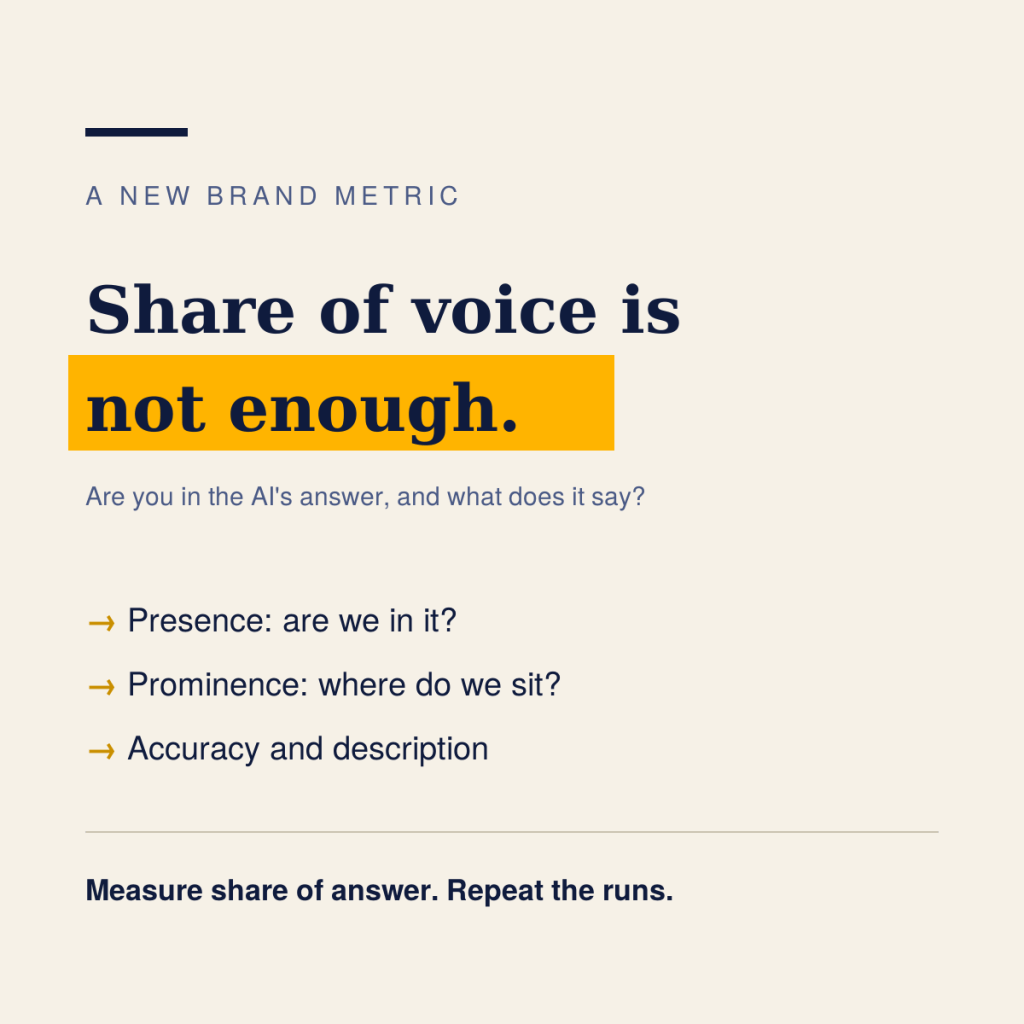
    Share of answer is the proportion of AI-generated answers to a fixed set of customer questions in which your brand appears. For example, if you ask 20 questions five times each and your brand shows up in 30 of the 100 answers, your share of answer is 30%.

    It differs from older measures in three ways:

    • It is about answers, not pages. Share of voice counts mentions across media. Rankings count positions in a list of links. Neither tells you what a person who asked an AI actually saw.
    • It needs a fixed question set. An answer has no “search volume” to weight it, so you choose the questions, based on what your customers really ask before buying.
    • It is more than a count. Being in the answer is the first test. Being described correctly, and in a way that helps you, is the second. I handle this with a scorecard later.

    It is also not a ranking position or a guarantee of traffic. A brand can be in the answer and get no visit, and the metric is meant to capture exactly that gap.

    One reading is never enough

    AI answers change from one run to the next. SparkToro, with Gumshoe.ai, had 600 volunteers run 12 identical prompts through ChatGPT, Claude and Google’s AI about 2,961 times in total. Each response was turned into an ordered list of brands or products and compared. The responses almost never matched. For ChatGPT and Google’s AI, the chance of getting the same list twice in 100 runs was under 1 in 100, and an identical order appeared about once in 1,000 runs (MediaPost).

    Three caveats from the same report. The article gives no fieldwork dates and does not share the full method. Results were steadier in smaller markets, such as regional services and niche B2B tools. And the study did not look at how brands were described, only whether and where they appeared.

    The lesson is not that tracking is pointless. The same coverage notes the researchers concluded it is not useless. The lesson is that a single screenshot of one answer is an anecdote. A defensible metric averages many runs over a fixed question set, and reports a range, not a point.

    How to measure it

    This is a working method. The numbers in it are starting points, not proven thresholds. One AI-visibility vendor suggests 100 to 200 prompts, 3 to 5 repeats per prompt and weekly runs, but gives no data behind those figures (LLM Pulse). Adjust to what you can sustain.

    1. Build the question set from real customers. Draw on sales calls, service tickets, search queries and community threads. Cover three kinds: category questions (“which lender should I choose?”), comparison questions (“X versus Y”) and situation questions (“what suits a first-time buyer?”). Start with 20 to 30 you can run by hand, then grow.
    2. Fix the list of competitors and the AI tools. Track the same rivals and the same tools each time, such as ChatGPT, Gemini, Perplexity and Google’s AI answers, and report each tool separately.
    3. Run each question several times. Given how much answers vary, repeat each question at least three times and use the average. Use a fresh session each time so earlier chats do not colour the result.
    4. Record the same things every run. Whether your brand appears, where in the answer, what is said about it, which sources are cited, and which competitors appear.
    5. Repeat on a schedule. Monthly is realistic for a team doing it by hand. Hold the question set steady for at least a quarter so trends mean something, and add new questions as a separate list.
    6. Keep the raw answers. Store the text, tool and date of every run so you can audit a score later and show a leader what the AI actually said.

    The four-part scorecard

    Share of answer on its own can flatter you. A brand that is mentioned often but described wrongly is losing, not winning. I suggest four scores, all my own proposal, each worked out per tool and per question group.

    ScoreQuestion it answersHow to calculate itRead it with care because
    PresenceAre we in the answer?Answers that mention us ÷ answers sampledAverages hide big differences between question groups
    ProminenceAre we near the top or buried?Share of answers where we are named first, or in the first two namesOrder varies a lot between runs, so use averages over many runs
    AccuracyIs what it says about us right?Answers with no factual error about us ÷ answers that mention usNeeds a person to check against your fact sheet
    DescriptionIs the framing helpful?Answers that describe us the way we want to be seen ÷ answers that mention usSubjective, so use a written rubric and two reviewers

    Read them together. High presence with low accuracy is a repair job on your facts. Low presence with high accuracy is a visibility problem. Good prominence with a weak description points to a gap in your content or in what others say about you.

    How to report it and what to do with it

    Report it the way you would report any early-stage metric: as a trend with a range, and with the questions behind it.

    • Show a range, not a single number. “Between 25% and 35% across three runs” is more honest than “30%”, and it protects you when next month’s reading dips for no reason.
    • Split by question group. Category questions often matter most for new customers. Comparison questions show who you lose to. Keep them separate.
    • Put it beside the outcome metrics. Place share of answer next to branded search, leads and applications for the same product, so leadership sees whether visibility is moving results. I would not claim causation on one quarter of data.
    • Turn each gap into an owner and an action. A wrong fact goes to the product team. A missing answer goes to content. A weak third-party description goes to PR and reputation work.
    • Set targets cautiously. Start with “improve our own baseline” and a floor for accuracy, not a share target borrowed from a vendor benchmark.

    Pitfalls and limits

    • Volatility. As the SparkToro work suggests, order and list contents change run to run. Use averages and ranges, and distrust any score shown to one decimal place.
    • Your question set decides the result. Choose questions where you already look good and the metric flatters you. Write the list down before the first run and share it with someone who will challenge it.
    • Personalisation and location. What a customer sees may differ from what a fresh session returns. Treat your numbers as a consistent yardstick, not a picture of what every customer saw.
    • Tools change. A model update can move your score overnight. Note the date and tool version of each run so you can tell a real change from a platform one.
    • No access to the platforms’ systems. Google says no third-party tool has access to its internal ranking or AI systems (Google Search Central). Any paid tracker is sampling outputs like you do, so ask a vendor how many runs back each number.
    • Presence is not influence. Being in the answer does not show that it changed a decision. Pair it with business outcomes.

    Considerations for BFSI and fintech

    This section is my own analysis.

    In financial services the accuracy score matters more than presence. An answer that names you with an old rate, the wrong eligibility rule or a product you no longer sell is worse than not being named at all, because the customer arrives with a wrong expectation.

    • Weight accuracy highest. Treat any factual error about rates, fees, eligibility or risk as a defect to fix and log, not a data point to average away.
    • Keep a single fact sheet to check against. Reviewers need an approved source of truth, with a date, to score accuracy fairly.
    • Include the questions people ask when they are worried. Complaints, fees, safety and “is it genuine?” questions show how an AI describes your reputation, and they are where trust is won or lost.
    • Involve compliance in the question set. Decide up front how you will handle an answer that makes a claim about returns or advice, and who may report it to a platform.
    • Do not use customer personal data in prompts. Test with generic situations, not real customers’ details.

    A 30-day starter plan

    • Week 1: Pick one product line. Write 20 customer questions across category, comparison and situation types, and agree the competitor list and the AI tools.
    • Week 1: Write the one-page fact sheet that accuracy will be scored against, and agree a two-line rubric for “description”.
    • Week 2: Run every question three times in each tool, in fresh sessions. Save the full text, tool and date.
    • Week 3: Score presence, prominence, accuracy and description. Have two people score a sample so you can check they agree.
    • Week 3: List the gaps and give each an owner: facts, content, reputation or technical.
    • Week 4: Present the baseline as ranges with three actions. Agree the monthly rerun date and keep the question set locked for the quarter.

    The takeaway

    If customers increasingly ask an AI before they ask a search engine, then whether you are in the answer, and what it says, is a brand metric. It is noisy, it is new and nobody has standardised it. That is a reason to measure it carefully, with fixed questions, repeated runs and honest ranges, not a reason to wait. The brands that start a baseline now will know, a year from now, whether their work moved the answer.

    Sources

  • Mastering AEO: Your 90-Day Optimization Plan

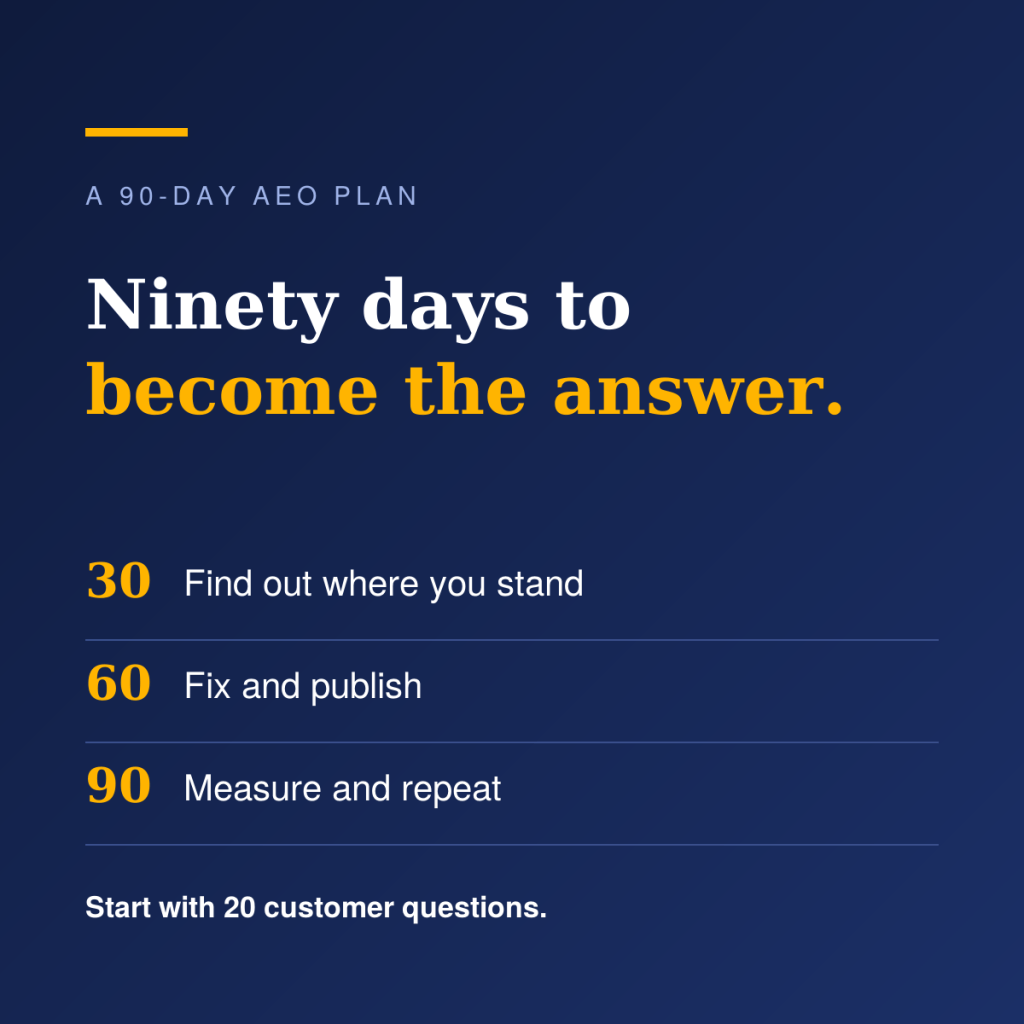
    A 90-day plan turns answer engine optimisation (AEO) from a vague worry into three phases: find out where you stand, fix what is wrong and publish what is missing, then measure and repeat. It needs no new budget, only an owner, a list of customer questions and the discipline to check the results.

    The reason to plan is that AEO is not a one-off fix. You are trying to become a source that AI answers can draw on, and that depends on many small things being right at the same time: clear pages, consistent facts, visible expertise and a reputation outside your own site. Doing one of them well does little. Doing all of them over a quarter starts to show.

    This post sets out the plan, a week-by-week schedule, how to measure it, and what to watch for in financial services. Where the evidence is thin, which is often, I say so.

    What is known, and what is guesswork

    Google’s own guidance is the firmest ground, and it is plainer than most AEO advice. For its AI Overviews and AI Mode, Google tells site owners to:

    • create original content with a unique point of view and first-hand expertise, and “don’t just recycle what others on the internet have already said”;
    • keep content people-first, clearly structured, and technically crawlable and indexable;
    • keep business and product data current in Merchant Center and Google Business Profile;
    • measure with the Generative AI performance report in Search Console.

    Google also lists what it says you do not need: new machine-readable or AI-specific files, special markup, rewriting content into tiny chunks, or special phrasing. It says structured data is not required for generative AI search, that an llms.txt file neither helps nor harms visibility in Google Search, and that “no third-party tool has access to our internal ranking or AI systems” (Google Search Central). An earlier Google post made the same point that clicks from AI Overviews tend to be higher quality, and that success should be judged on outcomes such as sales and sign-ups, not only clicks (Search Engine Journal, May 2025).

    That covers Google. ChatGPT, Perplexity, Gemini and others choose sources in ways they have not published. Most “AEO checklists” mix Google’s advice with practitioner opinion. One widely read playbook, for example, recommends a 40 to 80 word opening answer, set refresh schedules and a 30/60/90-day plan, but none of that is backed by cited data (ALM Corp). I use that kind of advice below as a sensible working method, not as proven rules.

    So the plan rests on one idea. The things most likely to help are the things that make you the best, clearest and most consistent source on your topic. If a tactic only makes sense as a trick, skip it.

    Days 1-30: find out where you stand

    The plans below are my working method, built on Google’s guidance and common practice. They are not a standard. Use home loans as the running example: swap in your own product.

    The first month is about evidence. Do not rewrite anything until you know what is wrong.

    1. Name an owner and pick one topic cluster. AEO touches content, product, compliance and web. One person needs to hold it together. Start with a single cluster, such as home loans, not the whole site.
    2. Build the question list. Collect 20 questions real customers ask before choosing: eligibility, rates, fees, documents, how long approval takes, how you compare with a bank or another lender. Use sales and service call notes, search queries, and your own site’s search box.
    3. Run the baseline. Ask each question in the AI tools your customers use (ChatGPT, Gemini, Perplexity, Google’s AI answers). Record for each: whether you appear, how you are described, who is cited, and what is wrong. Run each question more than once, since answers vary.
    4. Audit your facts. Check that rates, fees, eligibility rules and product names are identical across your website, app store listings, partner pages, social profiles and directories. Every mismatch is a risk, because a model may pick the wrong version.
    5. Check the technical basics. Pages must be crawlable, indexable and fast, and nothing important should sit behind a login or a script that blocks reading. Google says a page must be indexed and eligible to show a snippet to appear in its AI features (Google Search Central).

    Output of the month: a scorecard with your 20 questions, how you appear on each, and a ranked list of fixes.

    Days 31-60: fix and publish

    The second month turns the scorecard into changes. Fix the inconsistencies first, then fill the gaps.

    1. Lead with the answer. On each priority page, put a direct, plain-language answer near the top, then the detail. For “how long does home loan approval take?”, say it in the first lines, with the conditions that change it. Write in short paragraphs that each cover one idea.
    2. Say something original. Google’s advice is to avoid recycling what is already online. Add what only you know: your real approval process, your own data on how long things take, how a customer’s situation changes the answer.
    3. Show who is behind it. Add a named author or reviewer, their credentials, and a last-reviewed date. Make substantive updates, not cosmetic date changes.
    4. Close the gaps. Publish clear pages for the questions your baseline showed you missing on. Keep each one focused on a single question or decision.
    5. Use the same words everywhere. Pick the primary name for each product and term, and use it consistently, adding alternatives only as plain synonyms.
    6. Build credibility off your site. Contribute expert commentary, publish original research or data where you have it, and make sure reputable third parties describe you accurately. Google says seeking inauthentic mentions is not helpful, so this is about earning coverage, not manufacturing it (Google Search Central).
    7. Keep business data current. Update Google Business Profile and any product feeds you use.

    You do not need to add special markup for AI answers. Google says structured data is not required for its generative AI features. Standard markup that matches what is visible on the page is still fine for other reasons.

    Output of the month: revised priority pages, new pages for the gaps, and one fact sheet of approved product details that everyone in the company uses.

    Days 61-90: measure and repeat

    The third month shows what moved and sets the habit that keeps it moving.

    1. Re-run the baseline. Ask the same 20 questions, the same way, in the same tools. Compare with day 1: did you appear more often, was the description correct, who else was cited?
    2. Read the Search Console report. Google points site owners to the Generative AI performance report in Search Console (Google Search Central). Check which pages show up and for which queries.
    3. Look at the business outcome. Compare leads, applications and branded search for the optimised cluster against a similar cluster you did not touch.
    4. Keep what worked, fix what did not. Pages that earned citations show you the pattern. Pages that did not need a clearer answer, better proof or a fix to a conflicting fact elsewhere.
    5. Extend to the next cluster and set a rhythm. Make the question check a monthly habit and review the fact sheet every quarter.

    Output of the month: a before-and-after report, a decision on the next cluster, and a standing monthly review.

    The plan at a glance

    [embed: node/c3d05eaf-6c78]

    Each phase has one output and one gate. Do not start the next phase until the gate is met, because fixes made on top of an unmeasured baseline cannot be judged. Assign one person to own the plan, and name a reviewer from compliance for the gates in months two and three.

    How to measure when clicks are not the whole story

    An AI answer can shape a decision without sending a visit, so clicks alone understate the effect. Google’s own advice is to judge success on outcomes such as sales and sign-ups, not only clicks (Search Engine Journal). A practical set, adapted from a common four-layer approach (ALM Corp), is:

    • Presence. How often you appear for your 20 questions, how you are described and who appears alongside you. Track it by hand each month, or with a tool if you use one, remembering that answers vary from run to run.
    • Search signals. Impressions and queries for the optimised cluster in Search Console, including the Generative AI performance report Google points to, plus the trend in branded search.
    • Referral behaviour. Visits that arrive from AI tools, which pages they land on, and whether they convert differently from other traffic.
    • Business outcome. Qualified leads and applications for the optimised cluster compared with a similar cluster you left alone.

    Two cautions. First, tools that promise an “AEO score” are working without access to the platforms’ systems, as Google itself points out, so treat any score as an indicator you cannot audit. Second, with one quarter of data and a small question set, you are looking for direction, not proof. Keep the question list fixed so the comparison stays fair.

    Considerations for BFSI and fintech

    In financial services a wrong answer is not just a missed click. A model that quotes an outdated rate, the wrong eligibility rule or a fee you no longer charge creates a customer expectation you then have to meet or correct. Four habits help:

    1. Make one fact sheet the single source of truth. Rates, fees, eligibility, documents and timelines, with an owner and a review date. Every page, listing and partner profile draws from it.
    2. Date everything that can change. A visible last-reviewed date and a clear statement of what the figures apply to give both readers and machines a way to tell current from stale.
    3. Put compliance in the workflow. Have compliance review answer-first pages once, then use approved wording and disclosures as templates, so you can publish quickly without reopening each claim.
    4. Monitor for wrong answers, not just missing ones. When your baseline finds an AI answer that misstates your product, log it, fix the conflicting source if there is one, and report it through the platform’s feedback route where one exists.

    Be cautious about promising returns or outcomes in answer-style content. Read your regulator’s advertising rules and each platform’s policies for financial content before publishing at scale. I have not reviewed them for this post.

    Common mistakes

    • Chasing hacks. Google says you do not need new files, special markup, tiny content chunks or special phrasing, and that an llms.txt file does not affect Google Search. Spend the time on the content instead (Google Search Central).
    • Mass-producing pages. Google calls churning out pages to manipulate rankings or AI responses scaled content abuse. A few strong pages beat hundreds of thin ones.
    • Rewriting without a baseline. If you do not record where you started, you cannot tell what worked.
    • Fixing the site and ignoring everything else. Conflicting facts on partner pages, listings and old PDFs can undo the work.
    • Treating it as a project with an end date. Answers and sources keep changing. The monthly question check is the part that lasts.

    The takeaway

    AEO is not a new trick to learn. It is the old discipline of being the clearest, most accurate and most credible source on your topic, applied in a way you can check. Ninety days is enough to find out where you stand, fix what is wrong and see whether it moved. Start with one cluster, one owner and 20 questions. The brands that do this early will have the habit in place when the rules harden.

    Sources

Create your own website, free on WordPress.com.Create your own website.
Start free